Walk into an event, any event where you could be meeting people. It could be a cocktail party, a PTO family social at your child’s school, on the bus or subway on your commute, or even just sitting next to someone in the doctor’s office waiting room. What is one of the most common questions you ask or will be asked when you meet someone new?
“What do you do?”
This question immediately bubbles up feelings on the inside of us as soon as it gets asked. Sometimes, the anticipation of that question awakens those feelings. It is a simple question. What is your job? What do you do for a living?
The range of feelings that begin to fester inside of us varies from person to person.
If you love your job, you may feel proud. If you are not happy with what you do, you may feel disgruntled or shame. Excitement, embarrassment, enthusiasm, anger, gratitude, worry, fear, and so many more emotions can creep up inside of us when we must tell someone what it is that we do.
Why does such a simple question ignite feelings, emotions, or even drama inside of us?
That answer could be remarkably simple or extremely complicated. That answer has layers. For the sake of this topic, I am going to address how it pertains to our identities.
Our identities are so important to us. A quick Google search says that identity is defined as “the fact of being who or what a person or thing is.” Our identities help us answer the question of “who am I?” How can that not be huge?
Shortcuts Into Who We Are
Our identity is tied to how we think and feel about ourselves. We have labels or categories that make up our identity.
Some of our identity is out of our control, such as race, our astrological sign, or the name we were given at birth. As young children, our parents, by raising us, directly or indirectly, tell us who we are, by where we live, by putting us in certain schools, or going to a certain church, for instance.
As teenagers and then into adulthood, much, but not all, of our identity, is under our control. We can be who we want to be. The choice is ours. We can choose to go to college or not and choose which college to go to. We can choose to get married or not and to whom. Many of us can choose how many children we have, if any. We can choose where we live, what job we have, and how we worship. We choose much of our own identity.
When we identify with something, we feel like we belong in that category, club, or group. It feels is as if we have a membership to that club. Identity gives us a sense of belonging. It helps define who we are. We label ourselves, identify with what that label represents, and then live by the qualities or beliefs within those labels.
Our Identities Change

Identity is not stagnant or final. Our identity is dynamic and evolves as we do.
When I was diagnosed with breast cancer at 37 years old, I rejected the fact that I was a cancer patient. My thoughts swirled around and I thought “This is something I did not choose. I do not want to be in that club!
I could not accept my breast cancer reality. I could not identify with pink ribbons, pink t-shirts, “Save the Ta Ta’s” bumper stickers, or even the month of October (Breast Cancer Awareness Month) for several years.
However, with time and mental and emotional labor, I embrace having had cancer. It is in part what makes me unique and gives me perspective. Having had cancer has played a major role in who I am today, and I am pleased with who I am. I am better for having gone through cancer. I have evolved and so has my identity.
Catalytic events, traumas, force us into a changed identity, as my breast cancer diagnosis did.
The more empowering, liberating option, is the power to choose who you want to be and how you will show up in your life.
Thoughts Create Emotions
It is human nature to feel pride and promote what is good about ourselves. And on the flip side, we want to suppress and hide the negative aspects of our identity.
On one hand, a person might proudly say, “I have a Ph.D. in Education” but that same person rarely mentions and maybe even avoids in their mind the fact that they once had a DUI.
Another person might be delighted to say “I own my own software company,” but that person will sidestep questions about family or children because of all the suffering from multiple miscarriages.
Back to the question, “What do you do?”
The feeling you get when asked that question depends partly on how you think it contributes to your identity. If you think positively about your job, then the feelings you have about that job will be positive and you will gladly speak about what you do.
On the other hand, if you think about your job in a negative aspect, then your feelings will also equate to negativity and you will be quick to change the subject when in conversation about it.
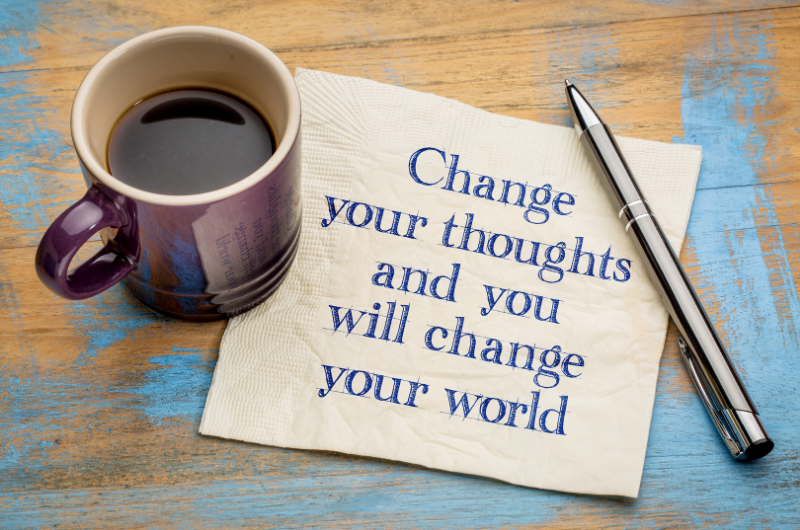
Notice that what you think about something creates how you feel about that something.
Our thoughts create our emotions.
Being Yourself Takes Courage
Our identities can make us feel vulnerable. Sometimes we label ourselves as to how we want to be portrayed and that label may or may not be 100% accurate based on how we are showing up in our lives. We might be showing up or living differently than how we have labeled ourselves. This creates unrest inside of ourselves because we are not in alignment. We are not fully living in integrity.
However, we are what we think ourselves to be. So, given that our identities can and do change over time, you can create your future identity.
- Who do you want to be?
- What do you want to do?
- How do you want to show up?
- How do you want to feel?
You get to decide.
Carl Jung said, “I am not what happened to me, I am what I choose to become.”
During the months when I was actively ridding cancer from my body and recovering from my procedures, I wanted nothing more than to get right back to my everyday, normal life. I thought going back to “normal” was the absolute best thing for me.
I did not know at that time as I know now but bouncing back was not the right answer for me or even the wish I should have had at the time. I needed to bounce forward.
I had to take my circumstance and all that it entailed and make something out of it. I had to do something with it. I had to have meaning come from all the grief. Hence, enormous personal growth and the birth of No Knockouts!
It takes courage to define your future self. Doing so can be scary. It can create a lot of self-doubts. It can even feel fraudulent when you are first acting out the new part. However, it is supremely satisfying!
It is amazing to define who you want to be and then become that person. Making that decision is powerful. Taking action on that decision, following through, and keeping promises to yourself is empowering. Getting the results you want is pleasing and rewarding.
So, even though some of our identities are defined for us, we get to ultimately choose who and what we want to be. We get one life on this Earth. Make it a good one!